The Bill Gross Email
In 1997 I pioneered paid search results and got buried in hate mail. Then Bill Gross emailed me. I almost didn't know who he was.
In 1997, Ken Covell and I thought we had figured out a clean way to make money from a search engine. We were wrong about the timing, right about the idea, and I almost sold the whole thing to a guy whose name I had to look up under my desk.
That last part still gets me.
Ken and I had left our previous lives in 1994 and co-founded InfoHiway Inc. By March 1995 we had built something genuinely strange and interesting: a distributed search engine network running on Perl, handling 12 million hits and 1.3 million visitors a month. The results page had a feature we called “Fuzzy Relational Links.” Readers could click to expand or narrow their results dynamically — the search was responsive to what you were actually looking for, not just what you typed. We also had a product called GeoSurfer in development, which would have done city-level local search. And we had built something we called Data Sucking Technology — DST — which stripped graphics and heavy HTML from sites in real time and delivered clean text synopses. We thought that was the future of navigating the web.
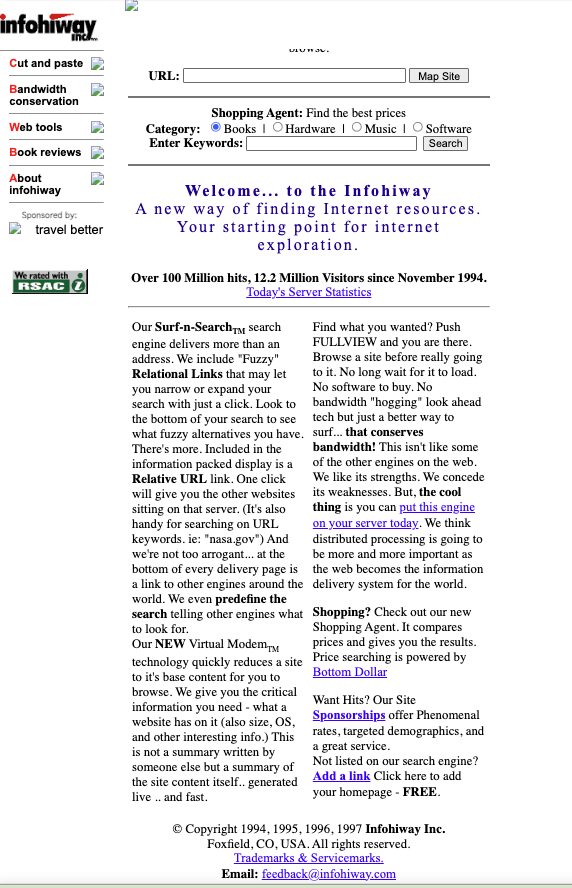
A lot of it was the future of the web. We just did not get to be the people who delivered it.
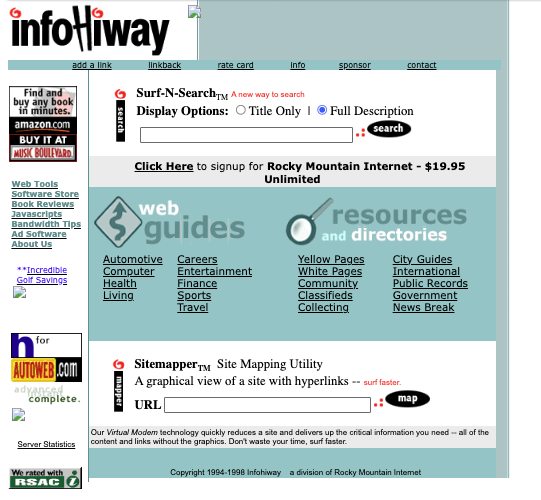
The idea we had in 1997 was simple. InfoHiway had indexed a lot of websites. Those websites were listed in our results for free. We decided to offer them the option to pay to appear in the top five results. They would still be in the index either way — we were just giving them a lever.
To make it easy, we built AdCafe — a self-serve app that let site owners place their ads on InfoHiway directly without going through us. Search engine, paid placement model, self-serve ad tool. The complete stack, built in 1997.
We sent the offer to every site we had indexed. Then we waited.
What came back was a wall of hate mail. Webmasters were furious. Livid, some of them. The accusation was that we were “ruining pure search results,” corrupting the sanctity of the index, turning a neutral tool into something paid and therefore compromised. The intensity of it surprised both of us. From where Ken and I were standing, we weren’t removing anyone — we were giving sites a choice they didn’t have before. But that was not how people saw it.
We were baffled. We were also, in retrospect, about two years early and a few hundred miles from Silicon Valley, which made it harder to read the room.
Somewhere in the middle of the backlash, an email arrived.
It was short. I remember it as spare to the point of being almost rude — though I do not think it was meant that way. Something like: have money, interested in buying your company. And a name. Bill Gross.
I read it and felt the faint tug of recognition without the content to back it up. The name was familiar in the way a lot of names in that era were familiar — you heard them mentioned, they moved through conversations, but the web had not yet produced the kind of instant-lookup reflex we all have now. There was no Wikipedia. There was no quick tab-open to fill in the context.
So I did what I actually did, which I am a little embarrassed to describe: I looked under my desk.
I had a pile of magazines on the floor. Sitting on top was a copy of Inc. And on the cover was Bill Gross.
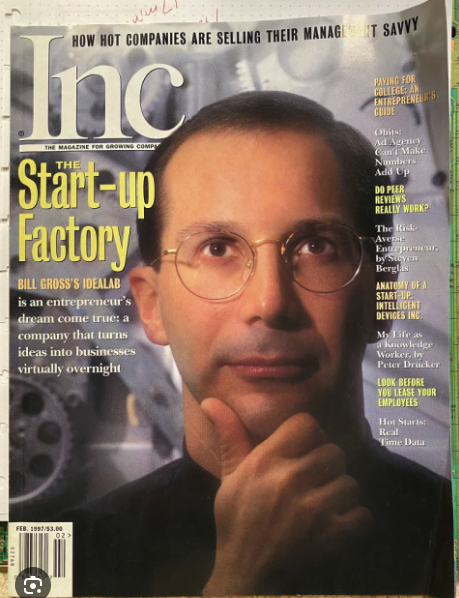
I held the magazine and looked at the email. The email and the magazine were saying the same name.
The moment I am describing is not one of those cinematic flashes of clarity where you suddenly see everything. It was more complicated than that. I knew who Bill Gross was now, in a general way — founder of Idealab, serious money, California, the kind of person who had conviction about where things were going. But I still did not know what he was building or why InfoHiway fit into it.
What I did know was that RMI.net — Rocky Mountain Internet, a regional ISP based in Denver — was also interested. RMI was real and present in a way that a cold email from someone I had just identified via a magazine cover was not. RMI was local. It was Colorado. The terms were concrete: roughly $1.2 million in RMI stock, about 150,000 shares, and both Ken and I would join the management team.
I chose RMI. InfoHiway was acquired in June 1998.
Six months after we closed, GoTo.com launched. Same model — pay to appear at the top of search results. Bill Gross’s company.
Years later, Yahoo acquired GoTo.com, by then renamed Overture, for $1.63 billion.
I do not lie awake about it. I want to be clear about that. The choice I made was not irrational given what I knew in 1998. RMI was a real deal, a clean close, Colorado, immediate. Bill Gross was a cold email and a magazine cover. The asymmetry of information at the time made RMI the sensible choice.
But I am also capable of doing the math. And the math is the math.
What I find more interesting now than the money is the pattern underneath it.
The “Fuzzy Relational Links” we had on InfoHiway in 1995 — the feature that let users expand and narrow results dynamically based on what they were actually after — was, in retrospect, an early intuition about something I have spent the last several years formalizing. Fuzzy logic is not just a feature name we thought sounded good. It is a mathematical framework for reasoning under uncertainty, for representing degrees of truth rather than hard binary cutoffs. The search behavior we were trying to enable was genuinely that: not “is this result relevant or not” but “how relevant is it, and in what direction do you want to go?”
I did not have that vocabulary in 1995. I was building by instinct.
Today, through Yodacom Research, I am doing the same work with different tools. The question is not “is this portfolio allocation good or bad” but “how good is it, under what conditions, and with what degree of confidence.” The fuzzy logic that names the research program is the same idea that named a feature on a Perl-driven search engine thirty years ago.
The Inc Magazine is long gone. The instinct apparently stuck.
If I had to summarize what the Bill Gross email taught me, it would be this: context is everything, and context takes time to arrive. In 1997, I could not see what Bill Gross was seeing. I was close enough to the idea that the whole paid-placement model felt obvious — we had built it, we had sent the emails, we had survived the hate mail. But I could not see where it was going because I was inside it, in Colorado, looking at a concrete offer from a local ISP.
The lesson is not “take the moonshot call.” The lesson is that you often cannot tell, in the moment, which thing is the moonshot. That is not a failure of judgment. It is just the actual shape of time.
I keep building anyway. The instincts seem to compound, even when the timing does not.