How Grid Trading Works — And Why the Mechanism Matters
Most people think about crypto as a directional bet. Grid trading reframes it as acting on movement rather than predicting it — and that reframe changes everything.
Updated October 22, 2026. I removed wording on this page that described grid trading as “income,” a “yield,” or a steady source of profit. Grid results depend on where price goes and what you still hold, and they can be losses. Nothing here is a statement about how any strategy has performed or will perform.
Most people who encounter crypto for the first time think about it the same way they think about a stock they are nervous about: will it go up, or will it go down, and which side of that bet am I on?
That is a reasonable first instinct. It is also, I think, the wrong frame for a class of assets whose defining characteristic is not direction but volatility. Crypto does not reliably trend up or down over any given month. What it does do is move — back and forth, within ranges, reacting to news and sentiment and liquidity in ways that are hard to predict directionally but statistically consistent in their amplitude.
The question grid trading asks is: what if you stopped trying to predict direction, and started acting on the movement itself?
The mechanics are simpler than they sound. You define an upper and lower price bound — say, $95,000 and $105,000 for Bitcoin — and divide that range into evenly spaced levels. At each level, the system holds a pending buy order just below and a sell order just above. When price drops through a level, the buy fills. When price recovers and crosses that level going up, the sell fills. The difference between the two prices — the grid spread — is the realized spread on that cycle.
One complete cycle: buy at $96,000, sell at $97,000. One thousand dollars of gross spread per bitcoin, before fees. Whether Bitcoin subsequently drops to $90,000 is irrelevant to that completed cycle. That completed cycle booked its spread.
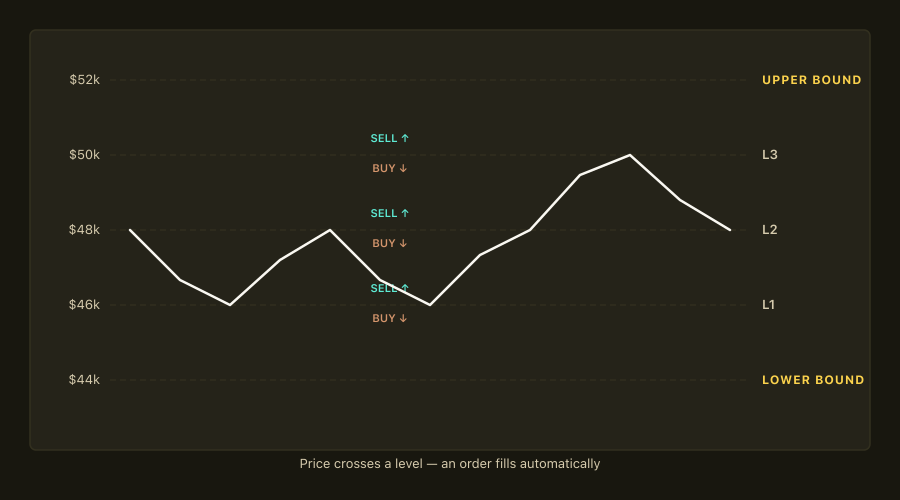
This is not a subtle distinction. It is the core of why the mechanism behaves differently from a long position. A buy-and-hold investor’s P&L floats with price. A grid trader’s realized gains from completed cycles do not depend on where price ends; the total result also includes the coin still held, which does. The more price oscillates within the range, the more cycles can complete, and the more a one-way move can hurt. A ranging market that leaves a long investor flat can still let a well-configured grid complete cycles and book realized profit. How much depends on volatility, configuration and fees, and a trending market can produce losses instead.
The configuration choices matter enormously, and this is where it becomes genuinely quantitative.
Tighter grid spacing means more levels within a given range, more crossings per day, more cycles completed — but smaller profit per cycle. Wider spacing means fewer trades, larger spread captured per trade, but longer wait times and fewer opportunities. The optimal configuration is not fixed: it depends on the volatility profile of the asset, the width of the current trading range, and the market regime you are operating in.
That last factor — regime — is the one most grid traders underestimate. A grid performs best in a ranging market, where price oscillates without establishing a strong directional trend. In a sustained bull or bear trend, the calculus changes. In a trending bull market, the grid keeps selling into rising prices — capturing spread, yes, but also missing the larger directional gain. In a trending bear market, the grid keeps buying into falling prices, and if price drops below the lower bound of the grid, you are holding inventory that has not found a sell. The strategy is not broken in those conditions, but it is not optimized for them either.
Knowing which regime you are in is at least as important as knowing how to configure the grid.
This is the part of CoinRoc that I find technically interesting, because it is the part that is hardest to do honestly.
Regime classification sounds straightforward. In practice, markets do not announce their regime. They transition gradually, with false signals in both directions. A ranging market develops a trend. A trend exhausts and reverts. The classifier that tells you which state you are in needs to handle uncertainty — not binary categories, but degrees.
The RXI™ regime engine in CoinRoc is built on a fuzzy inference system and uses fuzzy logic for exactly this reason. Rather than declaring “this asset is trending” or “this asset is ranging,” it quantifies the degree to which each regime applies, continuously updated as conditions evolve. This is the same mathematical framework I have used in Yodacom Research’s portfolio work for years: treating uncertainty as a property to measure rather than a condition to eliminate. Crisp rules fail at boundaries. Fuzzy membership functions are honest about the transition zones where markets actually spend most of their time.
The visual explainer on CoinRoc’s learn section walks through the mechanics step by step with charts that make the cycle structure and regime logic much easier to see than any prose description manages.
There is a parallel I keep returning to when I think about why this approach resonates with me.
RAMCAP, which I built in 1984, was an attempt to make portfolio analysis accessible to advisors who needed to make real decisions under uncertainty — not just compute correlations, but understand what those correlations implied for allocation under conditions that were themselves uncertain. The tool’s job was to bridge from accurate model to actionable decision. That gap, as I have written before, is still the gap I am most interested in.
Grid trading, as a systematic approach to a volatile asset class, is another instance of the same problem. Most participants in crypto markets are making discretionary decisions — reading charts, following news, forming directional opinions — in a context where the signal-to-noise ratio is genuinely poor. A grid strategy does not eliminate that noise. It structures a relationship with it. The volatility becomes the input to the machine, not the variable you are trying to outguess.
That reframe — from prediction problem to execution problem — is the intellectual move I find worth taking seriously.
A few things I want to be precise about, because the mechanism is genuinely interesting and deserves honest framing.
Grid trading does not remove risk. It transforms it. The primary residual risk is inventory risk: if the asset’s price falls through the floor of your grid and does not recover, you are holding depreciating inventory and your grid is inactive. This is real. It is why regime classification matters — you want to deploy in ranging conditions, not into a sustained downtrend. It is also why position sizing and capital allocation matter as much with a grid strategy as with any other.
The Grid % Return metric is annualized realized grid profit as a percentage of deployed capital. There is no fixed CoinRoc rate: Grid % Return moves with volatility, configuration and how long an asset stays in range, and it can be zero or negative. I would not pretend the risk profiles are equivalent. A CD’s return is guaranteed. A grid’s return depends on the asset continuing to trade within the configured range.
A grid is not a CD. It trades around the clock and you can close it any time, though not at a price you choose. Nothing is promised and it can lose money. The broader Learn section at CoinRoc covers the risk dimensions in more depth for anyone who wants to understand the full picture before deploying capital.
I find myself returning to this mechanism not because of any return it promises, but because the underlying logic is sound in a way that a lot of crypto strategies are not.
Most crypto strategies are directional bets dressed up in technical language. Grid trading is not. It is a structured relationship with volatility, implemented systematically, with completed cycles as the output. The mechanism can complete cycles whether price ends the month higher or lower than it started, if it moves enough within the range. What is left in inventory still decides the result.
For a class of assets that everyone agrees is volatile and almost no one agrees on the direction, that strikes me as the more honest starting point.
Past results from backtesting are not a guarantee of future performance. Grid trading involves risk, including the risk of loss of principal. This is not financial advice.
This document is for informational and educational purposes only. It does not constitute investment advice, a recommendation, or an offer or solicitation to buy or sell any security, digital asset, or financial instrument. The information herein reflects the views of the authors as of the date of publication and is subject to change without notice. Readers should consult their own financial, legal, and tax advisors before making any investment decision.
Digital assets, including cryptocurrencies, are highly volatile and speculative. They may experience rapid and substantial price declines, including a total loss of value. Regulatory treatment of digital assets is evolving and uncertain, and future regulatory actions may materially affect the value, legality, and accessibility of digital assets. Digital asset markets operate 24/7 and are subject to operational, custodial, and cybersecurity risks not present in traditional financial markets.