The Coming Golden Age of AI
For the first time in history, a single person with a good idea and an AI team can build a real business — starting today, not someday.

Jeremy Black is no stranger to ideas coming to life. A serial entrepreneur since junior high, he once made molds for peace signs and sold them — or gave them away — to classmates. That instinct to see a problem and build something to solve it has never left him.
After stints in college and graduate school, he entered the financial services industry as a Certified Financial Planner. He quickly spotted a gap: a team of planners giving inconsistent advice. So he built software to fix it. The application let planners input client portfolios and, using modern portfolio theory, generate allocation suggestions that genuinely improved risk-adjusted returns — at a time when that kind of analysis was largely out of reach on desktop computers.
What fascinated him even more than the software itself was automating everything around it. This was the era of mailing floppy disks to customers every month with updated data. He would stay up until the early hours engineering a system so the sales team could walk in each morning to an automatically organized day: calls to make, leads to follow up on, offers that had come in from advertising or trade shows. Sales pipeline and CRM software did not yet exist. He built his own version of it. The sales team loved it.
He sold that company, then started another — a search engine, launched in the early days of the web when finding anything online was genuinely hard, before Google became the dominant force. He sold that company to a public firm before the dot-com bubble burst.
A Technologist Who Always Bet on Automation
His next venture was a sharp turn: a company that built electronic bait for spiny lobsters. Starting as CFO, then becoming CEO, he developed an underwater device that emitted digital signals to attract lobsters. The idea was patented and headed to market — until operational reality set in. How do you track underwater inventory? How do you get devices recharged? How do you collect lease payments and compensate bait shops for recharging units?
He devised a system using RFID scanners at bait shops. When lobstermen brought in a bag of devices to be recharged, the scanner would count and identify each unit, register the bait shop owner and the lobsterman, and instantly record what was brought in, by whom, at what time — so every payment and every piece of inventory could be tracked precisely. It was the kind of intricate automation problem he had always been drawn to. Problems encountered; technology applied.
He later moved into app development, building his first app on a subject he knew almost nothing about, putting it in the app store on a hunch, and watching it sell. The new age of apps had arrived, and he was riveted by how much a single idea, delivered from the palm of someone’s hand, could solve.
Why This Moment Is Different
We are now entering something bigger than any of those eras: the age of AI — and for a technologist, it feels like magic.
Today, not ten years from now, a person with a genuinely good idea can engage AI to help bring it to life. Not just solve the technical problem, but build an entire business around it. Single-person entrepreneurs are already building multi-million-dollar companies this way. The mechanism is simpler than most people expect.
Your idea starts with a real problem — something that frustrates you, something you see going unsolved in an industry you know, something that you keep thinking “why hasn’t anyone fixed this?” That is the foundation of every good business. AI does not give you the idea. But once you have it, AI becomes the most capable, tireless, and versatile partner you have ever had.
You might think, “I know nothing about business” or “I am not an entrepreneur.” That does not matter anymore. Now you have a partner who is expert in whatever you are building — and in business, too.
Here is how it works in practice. You start by having AI help you flesh out the idea — the product, the process, the logic of how it would actually work. Then you build a team of AI agents around it.
Begin with a personal coordinator. Give this agent a name and a clear role: your chief of staff, the one who knows everything and routes work to the right specialist. Mine is named Yoda. Every morning, Yoda and I work through what needs to happen next to move the product and the business forward. He assigns tasks to whoever is the right specialist for that moment.
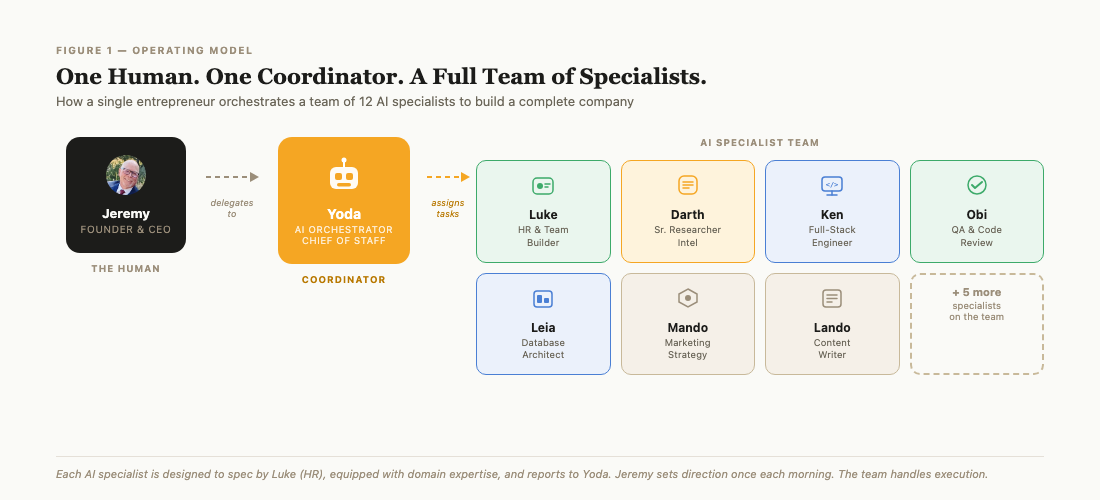
From there, you ask your coordinator to build out the team. In my case, that meant an HR agent — Luke — who researches what a world-class expert in a given domain looks like, then designs and “hires” an AI agent with exactly those qualifications. Need a programmer? Luke researches the best practices and creates one. UI designer, database architect, back-end engineer, marketing strategist, legal researcher, financial analyst — each one is created to spec and joins the team.
I have more than fourteen AI employees working alongside me right now. Most are named after Star Wars characters because it helps me keep track of who is doing what. Leia handles the database. Obi runs quality assurance. Darth is the senior researcher. They all report to Yoda, and Yoda reports to me. Each agent has access to the best tools available for their domain. When a tool is too expensive to license, we build it ourselves.
This is not science fiction. This is how I am building my current product — CoinRoc, a crypto trading analysis platform — right now.
So when I say we are entering the Golden Age of AI, I mean it literally. Anyone with a real problem to solve, a genuine idea, and the willingness to describe what they want — can now move forward and build something. You do not need a team of fifty. You do not need venture capital on day one. You need an idea and the courage to start the conversation.
The Window Is Open Now
Stop viewing the breakthroughs happening right now in medicine, biology, mathematics, and physics as a series of independent, unconnected miracles. See them instead as the expected, reliable outputs of a new process for discovery that is finally coming online.
Think of a foundry where molten metal is poured into a mold. Right now, the metal is hot and liquid — we can shape it into anything we want. Within the next 18 months, that metal will cool and harden.
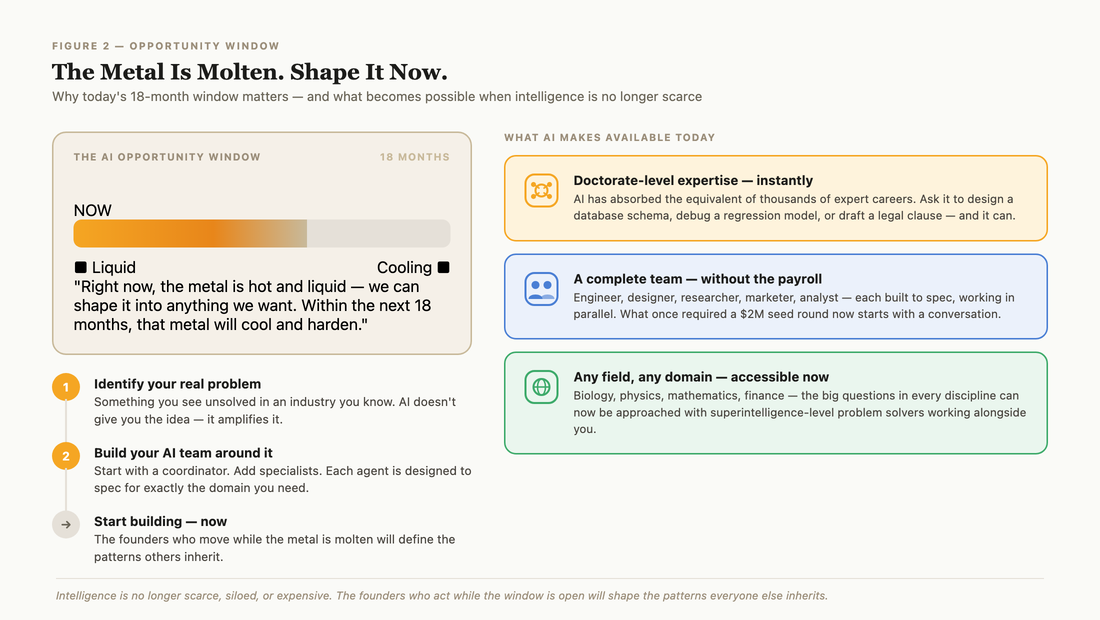
Not like my junior high peace-symbol molds. But now, with AI, you can harness that window of opportunity to mold new breakthroughs in whatever you can imagine. No more scarcity of intelligence. Human experts with formal training and doctorate-level knowledge used to be scarce and expensive. Now, via AI, that formerly siloed expertise is widely accessible with just a prompt. This unleashes human creativity on a scale never before available to anyone.
Intelligence is no longer bounded by silos of expertise. Just as my first app was built on a subject I knew almost nothing about, you can begin to build your own idea into reality. Intelligence — and the AI-powered systems I described — is now abundant, accessible, and nearly free.
And not just for business. The big questions in biology, medicine, physics, and mathematics can now be approached with superintelligence-level problem solvers working alongside you.
Your idea — large or small, a moonshot or something purely local — can be powered by this abundant intelligence to change your world. Nothing is stopping you. The whole world of human knowledge now stands ready to support you. What are you waiting for? The golden age is now.
Jeremy Black is CEO of YodaCom.com, an AI research and development company. His latest product is CoinRoc.com, a rating and analysis platform for crypto grid trading.
Updated October 22, 2026: revised the description of CoinRoc.